





.svg)


.svg)


Partner: Arkis
Integration: Staked position collateralization through P2P.org validator infrastructure
Use case: Credit and margin extended against staked assets, without unwinding the stake
The Challenge
Institutional holders of staked assets have faced a choice they would rather not make. Keep the position staked and collect protocol rewards, and a meaningful share of the balance sheet does nothing else. It cannot be pledged, margined, or deployed against another strategy. Unwind the position instead, and that capital becomes usable as collateral again, but only after giving up the reward stream and sitting through an unbonding period that can run several days.
Neither option touches the actual gap. The asset is sound, the validator operator is known, and the position is verifiable. What institutions have been missing is a counterparty willing to assess a staked position as collateral in its own right and extend credit against it.
The Solution
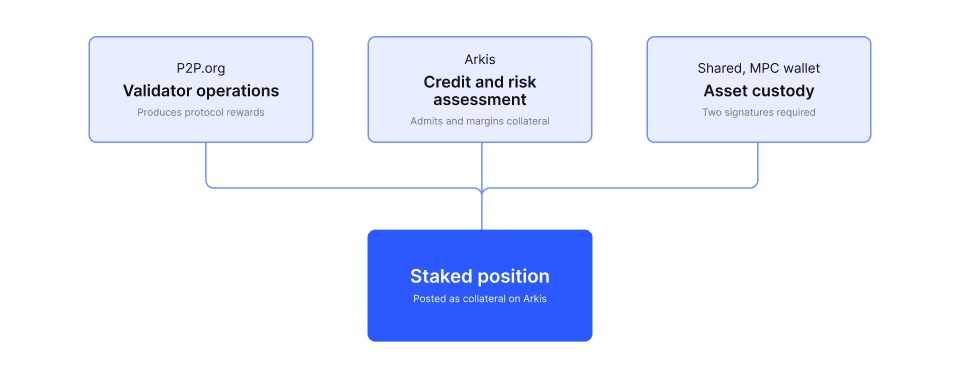
Arkis and P2P.org built an integration around a clear separation of roles. P2P.org operates the validator infrastructure and produces the protocol rewards. Arkis assesses the resulting staked position as collateral, admits it to a margin account, and manages the credit extended against it. The integration is live today, with eight assets staked through P2P.org accepted as collateral on Arkis: SUI, ADA, MON, TRX, SEI, NEAR, AVAX and TON. In Arkis Alpha, clients can see the trades available against those positions.
Three Functions, No Single Point of Control
Validator performance sits with P2P.org. Arkis handles credit and risk decisions. Assets backing the arrangement sit in a multi-party computation custody wallet shared between Arkis and the client, and withdrawal requires a signature from both parties. Neither Arkis nor the client can move the assets alone, and P2P.org holds no custody function in this structure at all.
For an institutional reviewer, that separation is the point. Validator operations, credit assessment, and control of the assets can each be examined against their own auditable boundary, rather than folded into a single combined counterparty exposure. P2P.org's side of that boundary rests on validators running across more than 40 proof-of-stake networks, over $10 billion in assets secured, a zero slashing incident track record, and SOC 2 Type II attestation.
Arkis's side rests on an institutional prime brokerage that margins CeFi, DeFi and TradFi positions as one portfolio, with over $250M in institutional credit deployed and zero bad debt since 2022, backed by Spark.
Why Staking Needed Its Own Risk Model
Arkis maintains a collateral assessment framework governing which assets are admitted to a margin account and on what terms. Admission is a risk decision measured against defined criteria, not a commercial accommodation, and the framework is built so new collateral types can be evaluated and onboarded as institutional demand appears.
A staked position does not behave like spot. It generates protocol rewards, carries a lock-up period, and settles on its own schedule. Treating it as collateral at all requires a risk model built to account for those properties directly, which is what makes a staked asset admissible on Arkis in the first place.
Staked Capital Stops Sitting Idle
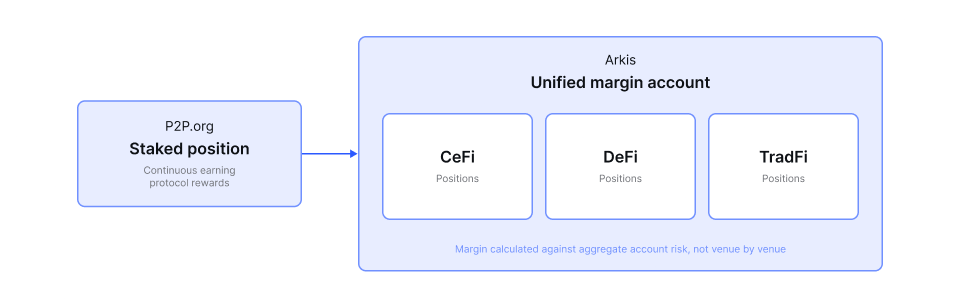
Once admitted, a staked position sits inside the same margin account as the rest of a client's portfolio. Arkis margins CeFi, DeFi, and TradFi exposure as one book, so collateral posted against one position supports positions taken elsewhere across the venues a client trades through Arkis.
For a client holding staked assets, the staking allocation stops sitting apart from the rest of the balance sheet. It continues earning protocol rewards on its own schedule, and it now also contributes to overall credit capacity at the same time.
What This Enables
For institutional clients staking through P2P.org and trading through Arkis:
- Collateral without unwinding: A staked position can be posted as collateral on Arkis without unstaking it first, so the client keeps the reward stream while the position supports credit.
- Independently auditable boundaries: Validator operations, credit assessment, and asset control sit with three separately accountable parties, reviewable as distinct exposures rather than one bundled counterparty risk.
- Rewards continue alongside credit capacity: The underlying stake keeps earning protocol rewards while also contributing to the client's credit capacity on Arkis.
Talk to P2P.org About a Similar Integration
Arkis is one credit provider treating staked assets as collateral. Institutions, custodians, and platforms evaluating a similar arrangement, whether that means assessing staked positions for credit, building unified margin across venues, or simply understanding what a staking operator needs to support this kind of use case, can get in touch with the P2P.org team to talk through what fits.
Further Reading
For more on how Arkis structures and enforces the credit and risk side of this arrangement, see how Arkis defines risk.


