




.svg)


.svg)


Introduction
As staking adoption accelerates, wallets and custody platforms face a key challenge: how to offer staking natively without managing complex validator infrastructure or exposing users to custody risk.
P2P.org's Unified API was designed to solve this. It provides a single integration that unlocks staking across multiple proof-of-stake networks — all backed by P2P.org's institutional-grade validator infrastructure.
Bron, an MPC wallet connected to Coppers custody ecosystem, became one of the first wallets to deploy Unified API in production. Within a few weeks, the team launched ETH and Solana staking directly inside the Bron app - fully non-custodial, with the fully non-custodial with strong security architecture security in the industry, and completely infrastructure-free.
Why Wallets Need Unified API
Running validators in-house isn't sustainable for most wallets.
Every new network requires separate infrastructure, slashing protection, reward tracking, and ongoing maintenance. It drains developer resources and introduces operational risk.
At the same time, users increasingly expect staking to be built into their wallets - frictionless, transparent, and secure.
P2P.org recognized that the bottleneck wasn't technical capability, but integration complexity. Unified API removes that barrier by turning staking into a service — one endpoint that connects wallets and custodians to fully managed, production-ready validators.
The Partner: Bron Wallet
Bron is an institutional-grade non-custodial wallet built on multi-party computation (MPC) technology and integrated with Copper.
Its design eliminates single points of failure, splitting private keys across multiple encrypted shards and enabling secure recovery mechanisms.
The wallet serves both retail and institutional users who require high security, flexible access control, and strong compliance standards.
Before integrating Unified API, Bron's team wanted to introduce staking but faced three constraints:
- Avoid deploying or maintaining validators.
- Preserve full non-custodial control.
- Deliver staking through a simple, in-wallet experience.
The Solution: Unified API Integration
Architecture Flow:
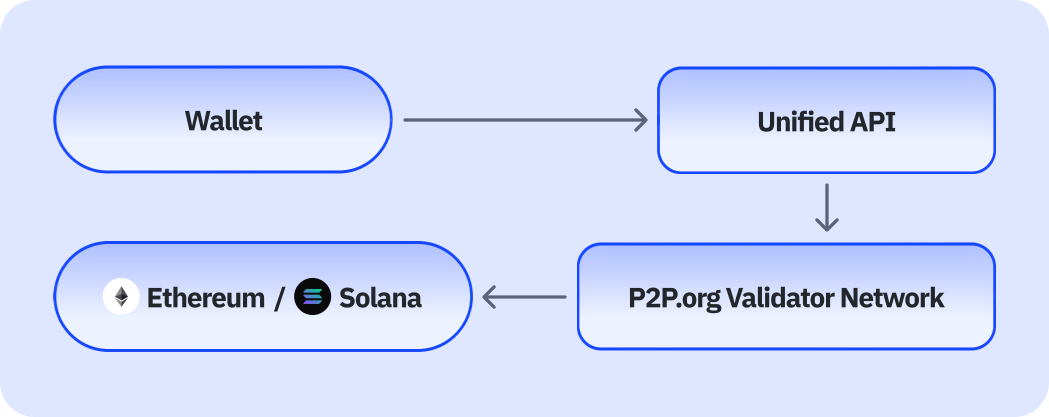
- Wallet Layer. Bron handles front-end UX, transaction signing, and key management.
- API Layer. Unified API provides standardized endpoints for delegation, staking, and reward tracking.
- Infrastructure Layer. P2P.org operates high-availability validator nodes with automated monitoring, slashing insurance, and reporting.
All staking transactions remain non-custodial. P2P.org never accesses private keys or user funds. The API facilitates the transaction lifecycle, while the user retains full control of delegation and withdrawal.
Results
- Time-to-market — < 1 month from initial integration to production
- Networks supported — Ethereum and Solana, expandable to 40+ supported chains
- Operational load — Zero validator or infra management required
- Security — 100% non-custodial; protected by MPC and Copper infrastructure
- Scalability — Ready to add more networks instantly via the same API
The integration positioned Bron as one of the first wallets offering dual-network staking within a fully non-custodial setup — proving the operational efficiency of Unified API.
Why It Matters for Wallets and Custodians
Unified API enables teams to:
- Add multi-chain staking through a single integration.
- Retain control of UX, branding, and monetization.
- Avoid validator infrastructure costs and maintenance.
- Reduce security risk through P2P.org's institutional-grade backend
For wallets, this means faster deployment cycles and a better user experience.
For custodians, it means offering staking-as-a-service to clients without introducing custody or compliance complexity.
"Security and control were non-negotiable for us. Unified API gave us the ability to bring staking into Bron without deploying any infrastructure. It just worked."
— Dmitry Tokarev, Founder, Bron
"Bron's integration shows exactly what Unified API was designed for: helping wallets scale staking securely, quickly, and at enterprise-grade quality."
— Alexander Loktev, CRO, P2P.org
Next Steps
Unified API is now live and available to new partners.
Wallets, custodians, and fintech platforms can integrate staking across multiple networks in weeks — not months.


